
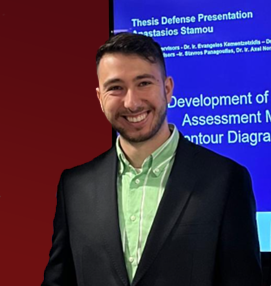
My academic background is in Civil Engineering. I hold a five-year Diploma from the National Technical University of Athens (NTUA), where I specialized in geotechnical engineering and completed my diploma thesis on structural health monitoring using wavelet-based methods. I also hold an MSc from TU Delft, from which I graduated cum laude. During my MSc studies, I specialized in hydraulic and offshore structures, and my master’s thesis focused on improving the assessment of soil liquefaction potential through advanced analytical and numerical approaches. In parallel, I was introduced to Data Science and Machine Learning for engineers, establishing a strong interdisciplinary foundation that bridges physical modeling and data-driven approaches. My research experience spans geotechnical and structural dynamics, signal processing, and physics-informed machine learning.
My doctoral research focuses on Artificial Intelligence methods for solving inverse problems and digital twin updating. In particular, I work on physics-informed and reliability-aware machine learning approaches that integrate physical laws with data to identify structural damage, quantify uncertainties, and track evolving system parameters. The overarching objective of my research is to develop robust and generalizable models that remain reliable under sparse, noisy, or partially observed data conditions.
I was inspired to apply as a PhD candidate researcher to the FOURIER project because of its strong emphasis on combining physics-based modeling, uncertainty quantification, and modern AI techniques within a collaborative European research environment. The network’s focus on real-world engineering applications closely aligns with my research interests and long-term ambition to advance trustworthy artificial intelligence solutions for infrastructure monitoring, assessment, and decision-making.